
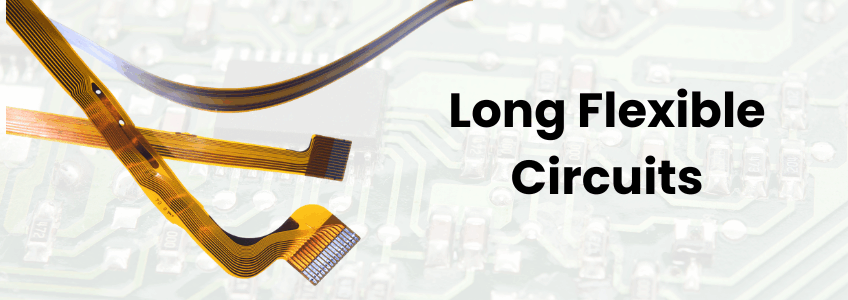
Long flexible circuits are increasing in popularity because they eliminate the need for long, bulky ribbon cables, which can be tedious to connect. Both thin and lightweight, this type of printed circuit conforms to contours and accommodates designs involving sliding components.
As with any circuit technology, the design needs depend on the application. We developed this guide to demonstrate the capabilities related to manufacturing long flexible printed circuits, and the areas to address when planning your design.
Top 5 Considerations in Designing Long Flexible Circuits

Long flexible printed circuit technology has remained widely unchanged; however, that does not mean it lacks versatility. These circuits are commonly found in advanced applications such as MRI machines, large-scale industrial LED lighting, and aerospace and transportation lighting, to name a few.
When designing long flexible circuits for your application, certain specifications should be taken into account. Below, we have outlined the primary factors that impact the manufacturability of your design.
1. Circuit Layers
The standard for long flexible printed circuits is 1-2 layers. Copper weight should be specified as 1-2 ounces, plated through holes on the ends.
2. Length and Width
Standard width requirements are 12” maximum. Length requirements can vary by PCB manufacturer, but typically fall within 1’ to 98.425’ (30 meters).
3. Mounting Holes and Plating
You can plate holes on long flexible circuits, but typically only on the 12” on the ends. Plated holes should stay at 0.01” as a guideline.
4. Space and Trace
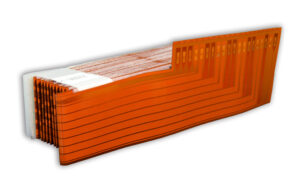
For circuits up to three feet, signal traces should be 0.01” wide with 0.012” spaces between them. Long flexible printed circuits over 3’ require signal traces that are 0.02” wide with 0.02” spaces between them.
5. PCB Edges
When designing long flexible printed circuits with copper to the edge of the circuits, leave approximately 0.02” from the last copper to the edge. This spacing allows
the circuit to be cut with a laser or other non-traditional methods. Some PCB manufacturers use die for cutting; however, when this method is used, the outlines will not align perfectly on every step.
View our comprehensive PCB design checklist!
Long Flexible Printed Circuits: The Final Word
Flexible printed circuits offer several benefits and are ideal for applications involving complex shapes and non-standard lengths. When used as a replacement for wiring, these circuits reduce the possibility of connection errors and make connecting components easier and faster.
Only a handful of companies manufacture long printed circuit technology. Tramonto Circuits has manufactured thousands of these circuits over the years. Our processes allow us to produce flexible printed circuits in variable lengths, up to 30 meters long to date, while achieving a quality ratio of over 99%.
Submit your design files, and we will help you develop a custom solution that exceeds your expectations. Contact us to learn more and explore all of the flexible circuit technologies we offer.